










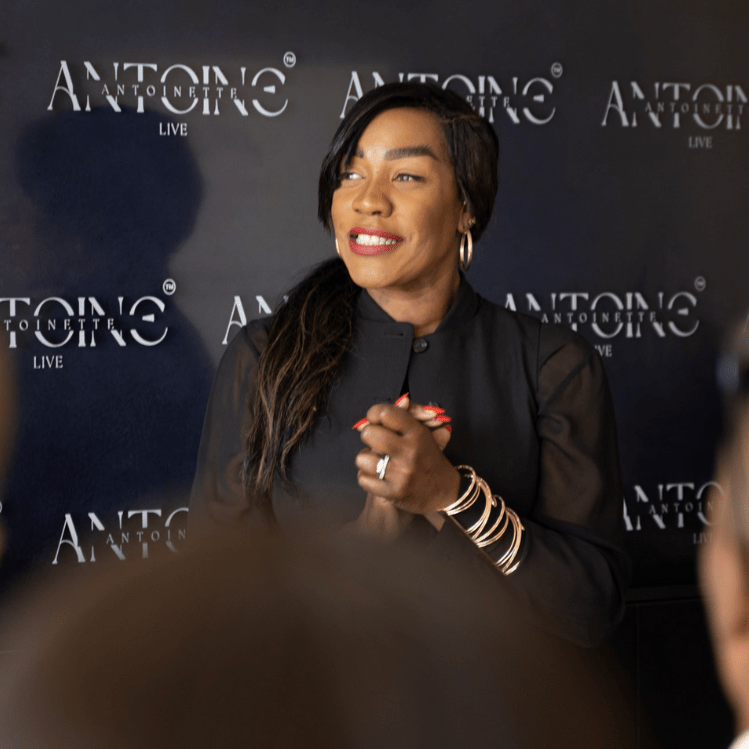
Antoinette Antoine doesn’t just coach leaders—she helps them rebuild themselves. As an Executive Reinvention Partner for high-performing men, she brings clarity, challenge, and confidentiality to a space often resistant to emotional vulnerability. Drawing on her own experiences navigating divorce, personal crisis, and high-stakes boardrooms, Antoinette teaches that reinvention isn’t optional—it’s strategic. She shows leaders how to dismantle outdated identities, rebuild with intention, and lead with both ambition and emotional integrity. For her, reinvention isn’t a soft skill; it’s the steel frame that supports lasting leadership.
“Reinvention isn’t a luxury—it’s strategy. To lead, you must rebuild with courage and honesty.”
You describe yourself as an Executive Reinvention Partner for Men. How does a woman gain credibility in a space that’s traditionally resistant to emotional vulnerability?
Because I don’t tiptoe around the truth, and high-performing men respect that.
Not all men need softness; they need clarity, challenge, and confidentiality.
I’ve led in some of the toughest environments — megaprojects, construction, crisis-driven boardrooms. Men trust me because I understand pressure, ambition, ego, and the emotional cost of success.
They can feel that I’m not intimidated by their title, their story, or their struggle.
Credibility comes from presence, not gender.
What personal experience taught you the most about what it really takes to rebuild while still leading?
Rebuilding after divorce while still delivering at an executive level.
It’s one thing to coach reinvention; it’s another to lead teams, sign off on multi-million-pound decisions, and still come home to a life that’s falling apart.
Rebuilding taught me this:
Strength isn’t pushing through — it’s making the uncomfortable decisions that protect your future self.
Reinvention is built on boundaries, hard truths, and self-respect
Many women are now leading conversations about emotional intelligence. Why do you believe this work must also intentionally include men?
Because emotionally intelligent women working alongside emotionally disconnected men is a recipe for friction, burnout, and broken leadership.
When men don’t do their inner work, organisations suffer.
When they do, teams stabilise, communication improves, and performance skyrockets.
We can’t build emotionally intelligent cultures if half the room is missing from the conversation. Men are not the problem — unprocessed identity rupture is.
You’ve navigated divorce, domestic abuse, and boardrooms simultaneously. How did those experiences shape the frameworks you use today?
My frameworks were born out of necessity, not theory.
I learned how to make executive-level decisions while living through personal storms.
That duality — performing externally while unravelling internally — taught me how identity fractures happen, how resilience is built, and how to rebuild without losing your ambition or dignity.
My work today blends strategic leadership thinking with emotional integrity because that’s what saved me.
What do you believe women misunderstand most about the way men process major life transitions?
That men don’t feel deeply. They do — they just hide better.
Men aren’t emotionless; they’re unpractised.
When men hit crisis points, their internal world collapses quietly:
careers, relationships, purpose, self-worth — all questioned at once.
Women often think men are detached.
In reality, men are overwhelmed and don’t have a language for it.
My work gives them the space and vocabulary they were never allowed to have.
What has been your biggest personal reinvention — and what did it cost you?
Leaving a marriage that no longer aligned with my purpose, identity, or future.
It cost me comfort, certainty, and the version of myself that kept shrinking to maintain peace.
But it gave me my power back — and my life expanded the moment I walked toward who I was becoming.
Reinvention always costs you the life you’ve outgrown. And that’s a price worth paying.
When you meet high-performing men in crisis, what’s the first thing you listen for?
I listen for the sentence they’re afraid to say out loud.
There’s always a moment where their facade cracks — a quiet admission, a fear, a truth they’ve buried under performance.
That’s the door.
The real work starts there.
How do you challenge a leader without damaging their confidence — especially at a moment when it’s already fragile?
Directly, but never destructively.
Men don’t need coddling; they need precision.
I challenge their thinking, not their identity.
I hold a mirror up with respect, but I don’t sugar-coat.
When someone’s confidence is shaky, insight must be sharp, not blunt-force.
My rule is:
Stretch them, don’t shatter them.
You often say “reinvention is not a soft skill.” What do you mean by that?
Reinvention requires strategy, discipline, emotional intelligence, risk tolerance, decision-making power, and relentless honesty.
There’s nothing soft about dismantling the identity you’ve built for 20 years.
Reinvention is infrastructure work — foundational, structural, and essential.
If leadership is the skyscraper, reinvention is the steel frame.
What is one cultural myth about resilience you wish women would stop believing — for themselves and for the men in their lives?
That resilience means “carrying on regardless.”
It doesn’t.
True resilience is the ability to stop, reassess, and rebuild before you break.
And here’s the myth I want women — and men — to abandon:
Self-sacrifice is not strength.
It’s depletion.
Real resilience is rooted in self-preservation, not martyrdom.
“Resilience isn’t carrying on—it’s stopping, reassessing, and rebuilding before you break.”