










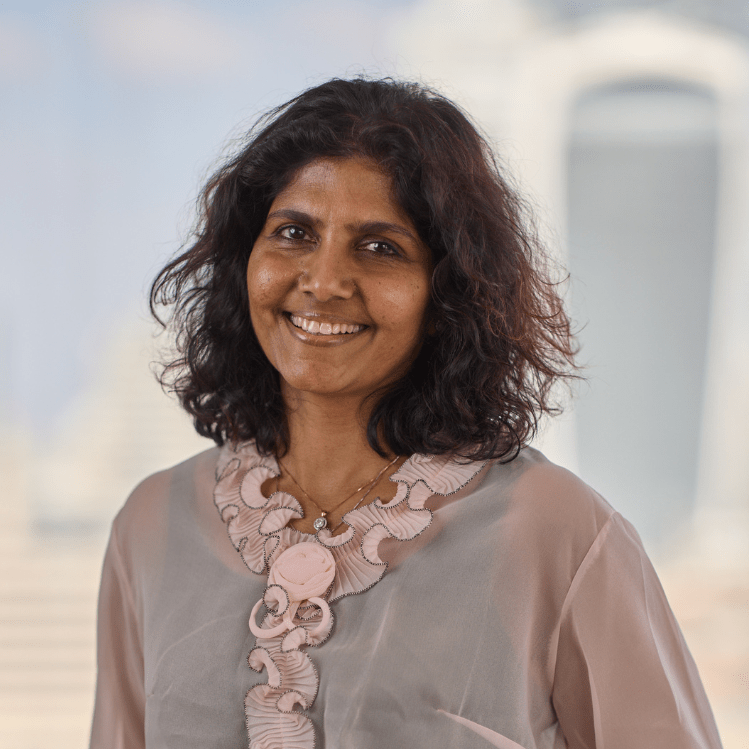
Arokia Antonysamy is a psychiatrist, innovator, and leader whose work sits at the intersection of clinical rigor, empathy, and systems change. Shaped by her experience as a female leader in psychiatry, she brings a distinctive lens to innovation—one that centres unheard voices, challenges entrenched models of care, and prioritises patient safety alongside progress. Her leadership is grounded in the belief that meaningful transformation in mental health emerges not from disruption alone, but from inclusive, evidence-based approaches that keep humanity at the core of innovation.
“Meaningful innovation in psychiatry happens when empathy and evidence walk hand in hand, keeping humanity and patient safety at the core.”
How has your experience as a female leader shaped your approach to driving innovation in psychiatry?
Being a female leader in psychiatry has sharpened my sensitivity to voices that are often unheard from patients, carers, and even clinicians working at the margins of systems. Early in my career, I learned that authority is not always readily granted to women; it must often be earned repeatedly. Rather than hardening me, this experience strengthened my resolve to lead differently.
I lead with inclusion, curiosity, and courage. Innovation, to me, is not about dominance or disruption for its own sake, but about creating space for new ideas, diverse perspectives, and compassionate solutions. My experience navigating bias and underrepresentation has made me acutely aware of systemic blind spots, which is often where the greatest opportunities for innovation lie.
As a woman, I have also learned the power of resilience and adaptability. These qualities are essential when challenging entrenched models of care. They allow me to persist, to listen deeply, and to build alliances rather than silos. Ultimately, my leadership is shaped by the belief that meaningful innovation emerges when empathy and evidence walk hand in hand.
What challenges will you face when integrating technology like MindKonnect into traditional mental health systems?
One of the greatest challenges will be trust. Traditional mental health systems are rightly cautious, shaped by concerns around safety, accountability, and risk. Introducing a digital platform like MindKonnect requires me to demonstrate, repeatedly, that technology could enhance clinical care rather than undermine it.
Another challenge is cultural rather than technical. Many clinicians are already overwhelmed, and any new tool will be seen as an additional burden. I have to ensure that MindKonnect integrates seamlessly into existing workflows, reduces duplication, and supports, not replaces clinical judgment.
There are also regulatory and governance hurdles, particularly around data protection and clinical responsibility. Navigating these requires patience, transparency, and collaboration with stakeholders who often have very different priorities.
What would help me is grounding every conversation in patient benefit and clinical evidence. By positioning MindKonnect as a solution to real system pressures like long waiting lists, delayed assessments, inequity of access, we gradually shift scepticism into curiosity, and eventually into cautious adoption.
How do you approach risk-taking in healthcare innovation while ensuring patient safety?
I approach risk-taking in healthcare with humility and structure. Innovation always carries risk, but in mental health, the cost of getting it wrong can be profound. My guiding principle is that patient safety is the foundation, not the trade-off, of innovation.
I take calculated risks, not impulsive ones. Every new idea is stress-tested through clinical review, ethical reflection, and pilot implementation. I ask not only “Can we do this?” but “Should we, and under what conditions?”
I also distinguish between clinical risk and implementation risk. While clinical safety must never be compromised, implementation can and should be iterative. Small pilots, feedback loops, and phased rollouts allow learning without exposing patients to harm.
Finally, I involve patients and clinicians early. Risk feels very different when decisions are made collaboratively rather than in isolation. In healthcare, responsible innovation is not about moving fast, it is about moving wisely.
Which personal habits or routines have helped you sustain your energy and focus in a demanding field?
Sustaining energy in a demanding field requires intentional self-leadership. One habit that has been transformative for me is structured reflection. I regularly step back to ask: What is essential right now, and what can wait? This protects my energy from being consumed by constant urgency.
I also prioritise mental and emotional boundaries. As a psychiatrist, innovator, and leader, it would be easy to be perpetually available. I’ve learned that protecting focused thinking time is not selfish, it is necessary for high-quality decisions.
Movement and stillness both play a role. Physical activity like Yoga grounds me, while moments of quiet reflection help me process complexity and regain clarity. These routines help me remain centred in high-pressure environments.
Perhaps most importantly, I stay connected to purpose. When work aligns with values, equity, compassion and impact, energy is replenished rather than depleted. Purpose is the most sustainable fuel I know.
How do you foster a culture of collaboration among multidisciplinary teams in mental health?
Collaboration begins with psychological safety. I work intentionally to create environments where every discipline including nursing, psychology, psychiatry, technology and research feels respected and heard. Hierarchy may exist in structure, but not in voice.
I foster collaboration by aligning teams around shared outcomes rather than individual roles. When everyone understands the why, silos naturally soften. I also encourage curiosity, inviting team members to learn from one another rather than defend their own territory.
Clear communication is essential. Ambiguity breeds tension, while transparency builds trust. I ensure expectations, responsibilities, and decision-making processes are explicit.
Finally, I model collaboration myself. When leaders listen openly, admit uncertainty, and value diverse perspectives, teams follow suit. In mental health, collaboration is not optional, it is the engine of safe, effective care.
Can you share a moment when a patient’s feedback reshaped one of your projects?
Early in my work on risk assessment, a patient once said to me, “Every form you give me tells me what’s wrong with me, but none of them ask what’s helped me survive.” That comment stayed with me.
It fundamentally reshaped how I think about assessment and innovation. It directly influenced the development of the PARA tool and later MindKonnect, where strengths, context, and lived experience sit alongside risk factors.
That moment reminded me that patients are not passive recipients of care, they are experts in their own lives. When we listen carefully, they reveal blind spots that no dataset can capture.
Patient feedback continues to shape my work. It keeps innovation grounded, humane, and aligned with real needs rather than professional assumptions.
How do you translate complex research into solutions that have real-world impact?
Translation begins with simplification, not dilution, but clarity. I ask, What is the core insight, and who needs to act on it? Research only creates impact when it is accessible to those making day-to-day decisions.
I work closely with clinicians and stakeholders to convert findings into practical tools, frameworks, or workflows. Piloting is crucial, testing ideas in real settings exposes what works and what doesn’t.
Storytelling also plays a role. Evidence needs narrative to travel. When research is linked to real experiences and outcomes, it gains traction beyond academic circles.
Ultimately, impact happens when research respects complexity but delivers usability. My goal is always to ensure that evidence improves care, not just literature.
What role does empathy play in leadership within high-pressure healthcare environments?
Empathy is not a soft skill, it is a strategic one. In high-pressure environments, people are stretched, fearful of error, and emotionally exposed. Leaders who lack empathy create compliance, not commitment.
Empathy allows leaders to understand what teams are carrying beneath performance metrics. It helps prevent burnout, supports retention, and fosters trust. Importantly, empathy does not mean avoiding accountability; it means delivering it with humanity.
In mental health, empathy also shapes safer decisions. When leaders understand emotional dynamics, they anticipate risks earlier and respond more effectively.
Empathy anchors leadership in reality. It keeps systems human in environments that can easily become mechanistic under pressure.
How do you mentor emerging female leaders in medicine and mental health?
I mentor emerging female leaders by helping them build inner authority. Many women are highly capable yet hesitate to claim space or visibility. I focus on confidence rooted in competence and values, not external validation.
I also encourage strategic thinking, understanding power structures, navigating politics ethically, and choosing battles wisely. Mentorship is not about protection; it is about preparation.
Equally important is modelling balance and boundaries. I am honest about challenges, trade-offs, and setbacks, because realism empowers more than perfection.
Finally, I emphasise community. No woman should rise alone. Building networks of support, sponsorship, and shared learning is essential for sustained leadership.
What advice would you give women aiming to make a transformative impact in a traditionally male-dominated sector?
First, do not wait to feel “ready.” Readiness is often a moving target, and women are conditioned to over-prepare. Step forward with conviction and learn as you lead.
Second, anchor yourself in purpose rather than permission. Systems may not always recognise your value immediately, but clarity of purpose sustains momentum when validation is slow.
Third, seek both mentors and sponsors. Mentors advise; sponsors advocate. You need both.
Finally, lead in your own voice. Transformation does not require imitation. The qualities often undervalued in women including empathy, collaboration and reflection are precisely what complex systems need most.
Your difference is not a disadvantage. It is your edge.