





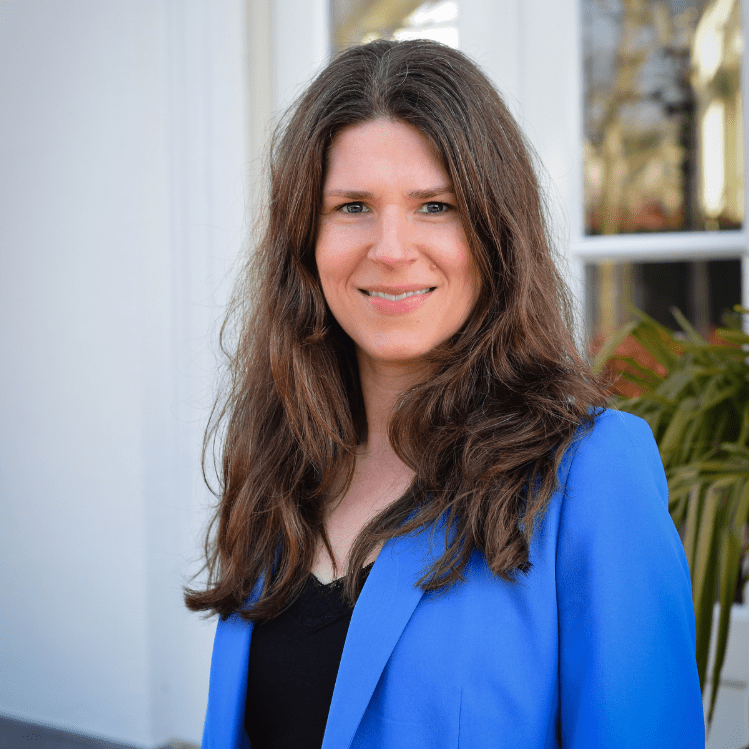
After hitting the wall of burnout, Ellen Duffy-Lueb realized that simply “getting by” wasn’t enough. Determined to never feel trapped by overwhelm again, she embarked on a decade-long journey of self-discovery – training as a stress counselor, mindfulness coach, holistic life coach, and energy practitioner. Today, Ellen empowers high-achieving women to reclaim control of their time, energy, and wellbeing through her 5-step FOCUS framework, proving that thriving in a high-paced world is possible without losing yourself along the way.
“Reclaim your energy, set boundaries, and thrive.”
Your journey from burnout to holistic coaching is inspiring. What was the moment you realized something had to change?
After I had landed in burnout and was coached back to being ‘functional’ by a career coach, I kept having this voice in the back of my head, saying ‘well, it (burnout) happened once – how will I know it won’t happen again?’. I had not been given the tools needed to make sure I would not land myself in a burnout again. At that moment I realized I needed to change – I needed to find the tools that would help me manage my high-paced life without the risk of burnout. So that was the start of a long self-development journey, starting with me becoming a Stress counselor – purely for myself.
I changed careers, had two children, and nearly burned out again. So I continued my quest for more insights and tools. I became a Mindfulness Trainer, Holistic Life Coach, and joined a spiritual program where I learned to actively work with energy. And finally, after nearly 10 years of searching and developing, I realized I had reached the point where I know that I will be ok, regardless of what life brings me. I now know I have the tools in hand to keep myself afloat in this high-paced world, and know how to thrive in it without losing myself.
How did your personal burnout experience shape the creation of your 5-step FOCUS framework?
Once I had gone through this self-development journey I also realized: this isn’t rocket science. But we have never learned how to actively do this! So I took the main puzzle pieces and put them together, creating my 5-step FOCUS framework. These involve the 5 steps needed to build a system for ourselves, which allows us to manage our energy, set clear boundaries, and reclaim control of our time in a sustainable way. Because I realized that this is what I needed in making sure I would never find myself close to burnout again, I started testing if it also worked for other women. And it turns out: it did! So I decided to pursue my mission of helping other (high-achieving) women to reclaim the control of their time and energy, so they too can thrive without burning out.
Many women feel guilty prioritizing themselves. How does your approach help them reclaim their time and energy without guilt?
The first step in my program looks at how and where we spend our energy. And 90% of our energy is spent in our heads – (over)thinking and (over)analyzing. I guide women through the process of gaining clarity in where their energy goes, and what choices they have once they have this insight. A lot of our energy is spent on worrying for and about others – what they say, do, or might think. When we learn to recognize this and see if those worries are indeed ours to carry, it can release us from that responsibility and that guilt if we don’t. It doesn’t mean that we stop caring – we can still be there to support the other – yet we can stop carrying the burden for them.
Not easy, no, yet it’s something we can all learn to do through practice – a skill we can learn.
Can you share one strategy from your “Reclaim Your Control: 7 Weeks to Sustainable Success” program that women can implement immediately?
Yes. So in step 1 we have identified where our energy goes (step 1 is called “Find and eliminate your (hidden) energy traps”). Then in step 2, we “Optimize your energy providers”. Here we look short-term and longer-term. For short-term, I provide an “Emergency Toolkit” – what to do in case of immediate stress or overwhelm. This is something we can all apply immediately, whenever needed:
1. Physically remove yourself from the situation (if possible – go to the toilet, kitchen, wherever. Just step away for a minute). This allows our system to start feeling safe(r) again.2. Take a deep breath – OUT. When we make our exhale longer than our inhale, we immediately let that energy that has been built up in our heads (the stress, the overwhelm) flow down through our bodies. We can even imagine that we let this energy flow down all the way through our feet into the earth, releasing it from our bodies altogether.
3. Go for a walk if you can. Ideally alone, no headphones, no conversations, no new information for your brain. The movement, the air, the daylight will all help your system to recover, and allow your mind some time to process the day so far. This is my lifesaver move, and I make it a point to go for a lunchtime walk every day – even just for 10-15 minutes. It makes a huge difference.
What role does mindset play in preventing burnout, compared to managing workload or external stressors?
Mindset certainly plays a role in the sense of what we tell ourselves. We cannot control our thoughts or circumstances, yet we can control how we choose to deal with them. Learning to recognize that we are not our thoughts is extremely helpful. I like to see my thoughts as another persona, called Auntie Bep, who likes to yap away in the background. I hear it, I recognize it, but I don’t need to do anything with these thoughts. They are not me. I get to choose what I want to do with them. And this is the true liberating factor.
Our workload and our external stressors can become quite manageable once we learn to catch the thoughts that we have about them. The funny thing about stress is that it is subjective – what is stressful to one person, might not be stressful to another. So the circumstance itself is not the main culprit, it’s the thoughts we have about this circumstance that make it stressful (or not).
And of course, time and energy management go hand in hand – one cannot function fully without the other. So both are addressed in my program, alongside Clarifying your goals, wants and needs (step 3); Using your time intentionally (step 4); and learning to Support yourself along the way (step 5).
How do you balance supporting clients while also maintaining your own energy and wellbeing?
Over the years, I have developed small habits for myself that I have implemented in my everyday routine. I start the day with connecting my energy to the earth and the universe and setting my intention for that day. I intentionally choose when to eat my breakfast (I do a light form of intermittent fasting) and what to eat to give my body the energy it needs. I do light exercise, take frequent short breaks, and take a mid-day walk. And then I have my evening routine that helps me process the day and prepare for the next day (physically, mentally, and energetically).
This is a routine that works for me. It addresses all three levels, making sure I feel calm, grounded, and energized – holding space for myself so I can also hold space for my family and my clients.
For women aspiring to leadership roles, what are the early signs of burnout they should watch for?
Feeling always in a rush, not being able to slow down, moving from task to task because they all seem equally urgent. Once we have lost clarity about how we want to spend our time and energy, and we feel like we are on a treadmill that cannot stop, that’s a sign that we might need to re-think how we address our time and energy. Are we still in control, or has your life been taken over by all the tasks and responsibilities on your plate? In the latter case – you will manage for a while, but you’re surviving. And surviving can only be done for so long. So have an honest look at how you go through your days – from a place of calm, clarity and focus; or from a place of rush, urgency, and feeling all over the place.
How do you help clients create boundaries in professional environments that traditionally reward overwork?
By switching the focus to output – results vs. time spent. What is it that needs to be done, and how can you get there? Start bringing clarity and focus into your calendar, block specific times to get certain tasks done and out of the way. A simple rule to remember is that 20% of our effort accounts for 80% of our output. This 20/80 rule is called the Pareto principle, after the Italian economist who discovered that this rule applies to just about everything we do. It also means that we need to let go of perfectionism – 80% is good enough! Trying to get to the full 100% will eat up a disproportionate amount of your time and energy (and trust me, as a recovering perfectionist this was a hard one for me to learn – but 80% really is good enough. No one even noticed the difference!).
Your work focuses on sustainable balance for body, mind, and soul. Can you explain how these three aspects interconnect?
Absolutely – we all consist of these three pillars: body, mind and soul. Addressing one without the other will give us some short-term results, but never a sustainable approach that will help us long-term. So my approach focuses on all three, making sure that every aspect of our being is recognized and optimized. Only in this way can we truly learn to thrive, without the risk of burnout looming over us.
Looking back, what advice would you give your 31-year-old self on managing ambition without burning out?
I would advise that it can be done, but it requires a different approach than what we are currently being fed by our society. So not to go along with the hustle culture taught by our societal systems, focused on just pushing through. But to explore other ways of working, that will still allow us to thrive without the risk of burning out. To reclaim the control of my own time and energy, to connect with my own drive and needs, and not give it away to others to determine what to do with it. In short, to become more intentional with, and take ownership of, how I spend my precious energy.
The final piece of advice I would give her is this: yes, you can do it all – just not all at the same time.